

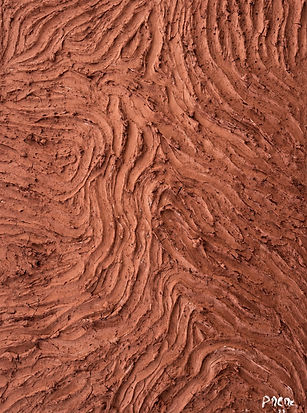
TRACE I, II and III, 2024
Private collection
Oil and concrete on canvas, 80 x 60 cm
Three panels in identical format, each carrying the same spiraling impression rendered in a different earthen palette: ochre, bone, terracotta. Built in thick relief from oil and concrete, Trace treats the mark as both fingerprint and geological strata, the singular gesture and the sediment of time. Each variation is the same impression made differently; what repeats also distinguishes.

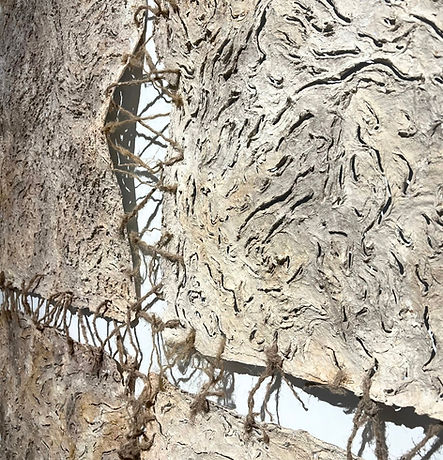
IDENTITES, 2024
Set of four oil on papier-mâché panels interconnected by rope threads, 170 × 110 cm
Four separate panels held together by rope threads passed through their edges, Identités makes visible the seams that bind a fragmented self. The cords do not erase the gaps between the panels; they expose them, insisting that the work of identity is precisely the labor of holding fractured parts in tension. What unites is also what reveals the divide.

À LA LISIÈRE DE L'OASIS, 2026
Currently in development for an art foundation
Textile installation, double-sided handwoven panels, welded stainless steel wire mesh armature, natural jute fiber, acrylic paint, approx. 65 m²

À LA LISIÈRE DE L'OASIS (DETAILS), 2026
A handwoven mosaic of dyed jute fibers stretched across a welded steel armature, this large-scale textile installation translates Pocol's painted topographies into a tactile, three-dimensional grid. The double-sided weaving, where each square reads differently from front and back, transforms surface into membrane. The fiber, dense, terrestrial, imperfect, carries the weight of the landscapes it suggests without ever depicting them.
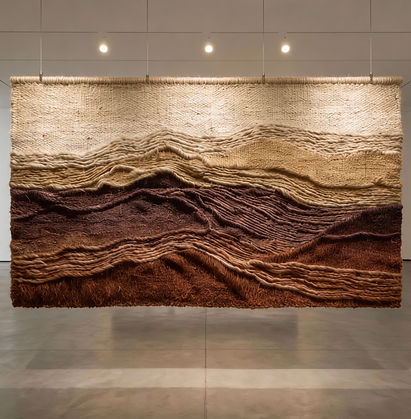


L’AUBE D’UN SOLEIL D’ÉTÉ, 2025
Private royal collection, Gulf region
Textile installation, double-sided handwoven panels, welded stainless steel wire mesh armature, natural jute fiber, approx. 200 × 400 cm
Built from layered jute strata woven over a welded steel armature, L’aube d’un soleil d’été compresses geological time into textile form. The stacked strata, reading like sedimented layers of memory, propose territory as something accumulated rather than depicted. The fiber retains its raw imperfection, refusing the smooth finish in favor of the trace of its own making.
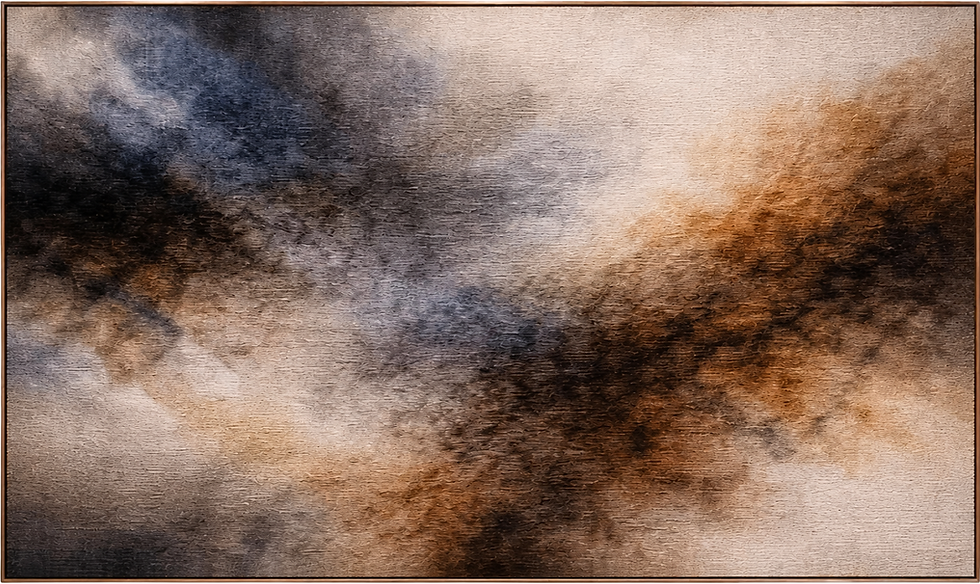
NUÉE, 2025
Private royal collection, Gulf region
Tufted textile, wool and cotton on primary tufting cloth, approx. 150 × 250 cm

GARDEN OF COLORS, 2025
Private collection
Oil on canvas, 170 x 170 cm
GARDEN OF COLOURS (STUDIO VIEW, SWITZERLAND), 2025
Painted in seismic ridges of self-mixed pigments, Garden of Colors compresses a full chromatic landscape into a single dense surface. At once geological and floral, mineral and organic, the painting operates as an internal garden where color carries the singularity of its making, each pigment mixed by hand, none reproducible. Light becomes material here, caught and refracted by the relief of the strokes.


ISLA BLANCA, 2025
Private collection
Acrylic on canvas, 100 × 100 cm

A diptych of dense oil ridges in deep blues and silvers, Sans Fin unfolds as an interior landscape, a sea or a memory turning back on itself. Painted in seismic strokes that catch and release light across the surface, the work proposes endlessness not as horizon but as accumulation, the impossibility of arriving fully at any single image of the self.
SANS FIN, 2024
Oil on canvas, diptych, 200 x 400 cm
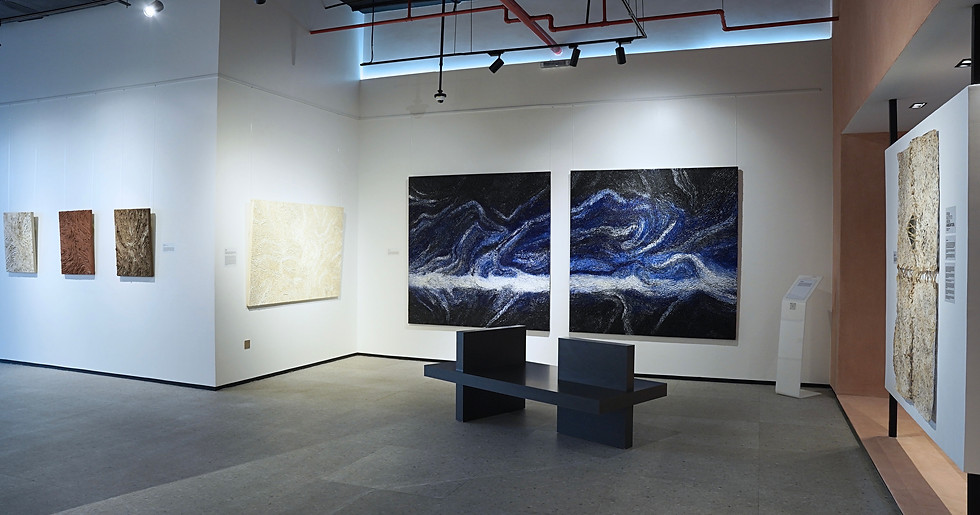
TRACE I, II, III, CONSCIENCE, SANS FIN and IDENTITÉS
Presented within the solo exhibition
From Roots to Vision. A Migration. , Ahlam Gallery, Riyadh, KSA, 2024

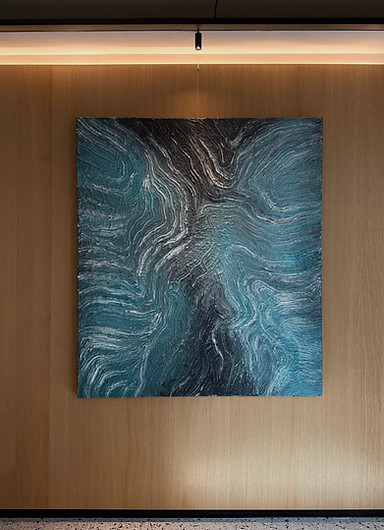
ORIGINES 106, 2025 (INSTALLATION VIEW, SICPA FOUNDATION, SWITZERLAND)
ORIGINES 106, 2025
Collection of the SICPA Foundation, Switzerland
Oil on canvas, 140 x 160 cm
CERTITUDE, 2024
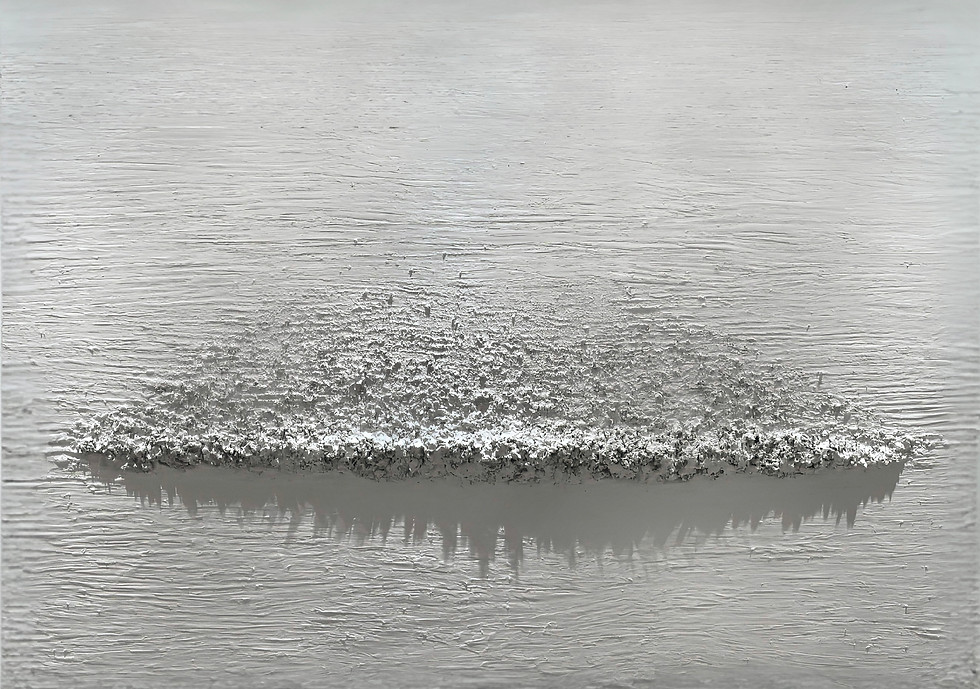
Private royal collection, Gulf region
Oil and concrete on canvas, 200 × 250 cm

CERTITUDE (DETAILS), 2024

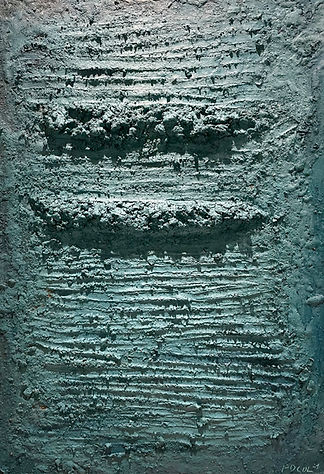
STRATES I and II, 2022
Private collection
Oil and concrete on canvas, diptych, 80 × 50 cm

PEUPLIER DE CARBONE, 2024
Metal armature, concrete, acrylic spray paint, epoxy resin, 80 × 158 cm

Within a welded iron cube coated in black, cocoon-like forms hang from each line of the structure. Each cocoon encapsulates an experience, a memory, or a wound, some sealed by hardened outer layers, others partially open to reveal interiors of vulnerable, painted matter. The work moves between protection and exposure, between the hidden and the revealed. The network it forms evokes the architecture of memory itself, where what is preserved and what is shielded share the same skeletal frame.
FUSION, 2025
Metal armature, plaster, papier-mâché, oil paint, acrylic spray and epoxy resin, 200 × 200 × 200 cm


UNTITLED, 2024 (left) and UNTITLED, 2024 (right)
Oil paint, recycled polyethylene and epoxy resin on canvas, 140 × 120 cm


WHEN THE EGGSHELL CRACKS, 2024
Metal structure, concrete, acrylic paint, recycled polyethylene, epoxy resin, approx. 168 × 98 cm


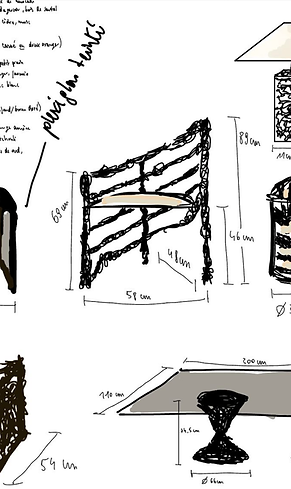
UNTITLED (CHAIR), 2025
Sculpted metal armature, cementitious adhesive, epoxy resin, leather upholstered seat 89 × 58 × 48 cm
Pocol's vocabulary of metal armatures, plaster, concrete and epoxy resin extends naturally from sculpture into objects designed for use. These pieces are not separate from the artistic practice but a continuation of it, where the sculptural gesture meets daily life. They share the same material density, the same refusal of finish, the same insistence that form must carry weight.
Preparatory drawings documenting the dimensional and structural development of the design objects.
%2C%202026%20(face).png)
%2C%202026%20(c%C3%B4t%C3%A9).png)
UNTITLED (TABLE), 2026
Two bases in steel, plaster, hemp fibre, acrylic paint, epoxy resin; tempered glass top, 72 × 80 × 180 cm

FRAGMENTS, 2024
Recycled paint tubes, acrylic and epoxy, 110 × 95 cm
Hundreds of emptied paint tubes, flattened and pressed into a single relief, form a surface made entirely of what painting leaves behind. The work shows the studio in reverse: not the canvas, but everything that was given up to make it.

ANTICONFORMISME, 2024
Acrylic spray and epoxy on canvas, 140 × 110 cm

UNTITLED, 2023
Acrylic spray on canvas, 70 × 40 cm

APRÈS L'INCANDESCENCE, 2026
Steel, plaster, hemp fibre, epoxy resin, acrylic paint, translucent elements, 167 × 91 cm
The sculpture takes as its starting point a body that has gradually covered itself in protective layers, until it closed in on itself. The incandescence has already taken place: part of these protections has given way, leaving the form in an intermediate state, neither closed nor reopened.
What remains is a threshold, where an old structure comes undone before another has yet taken hold. The tension between protection and exposure is left unresolved; it remains open to each viewer's reading.
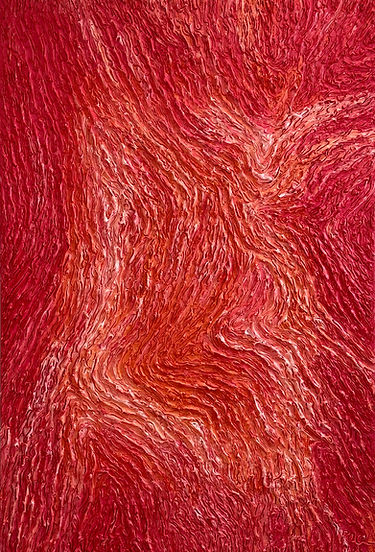
ELLES, 2024
Private collection
Oil on canvas, 120 x 80 cm

BLEUETS, 2025
Oil on canvas, 100 x 100 cm
The painting proceeds less from application than from excavation: worked in thick furrows, the matter organises itself around a dark centre toward which the entire surface converges. Blue dominates, shot through with whites, silver and violets that the reliefs hold deep within.
A state of withdrawal reveals itself here, an interiority closed in on itself to the point of letting through only a fragmented light.

NAISSANCE, 2024
Private collection
Oil on canvas, 145 × 105 cm

UNTITLED, 2024
Oil on canvas, 70 × 50 cm
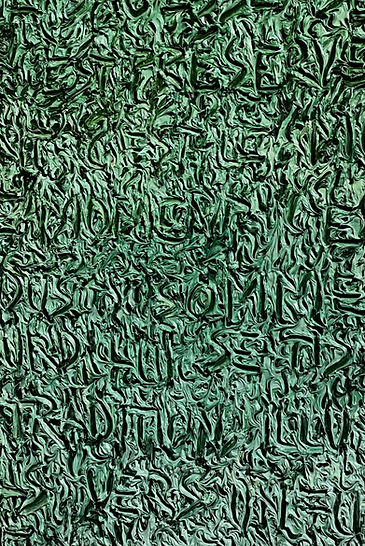

ÉVIDENCE, 2024
Private collection
Oil on canvas, incorporating an original poem by the artist, 120 x 100 cm
A handwritten poem buried within the painted surface, Évidence treats text as sediment. The words, dissolved by the oil's density, are not offered to be read but to be felt as another stratum: language reduced to material, language refusing to perform.
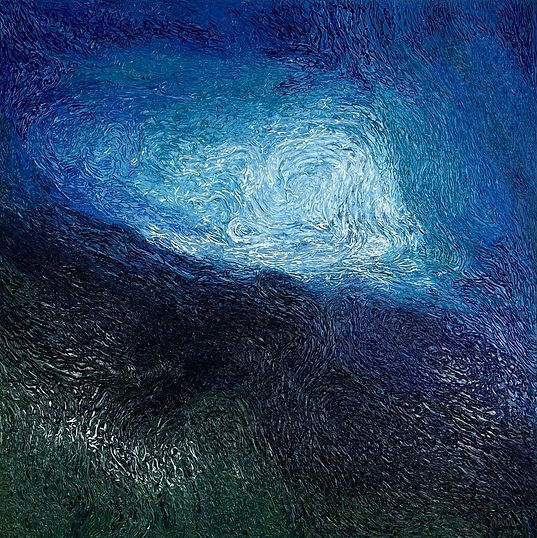

CAUMA, 2024
Private collection
Oil on canvas, 170 x 170 cm


ARCHITECTURES OF RELIEF: RIYADH, 2025 (left) and ARCHITECTURES OF RELIEF: AlUla, 2025 (right)
Collection of the Sigg Art Foundation, Switzerland
Oil on canvas, 120 × 170 cm each
Built from real topographic data of Riyadh and AlUla, translated by hand into paint, Architectures of Relief proposes a Saudi landscape where geology and construction belong to the same morphology. In AlUla, contemporary architecture disappears into the mountain, as if the relief itself had learned to build. In Riyadh, the city rises from the flat plateau, transforming geography into constructed topography. Between absorption and projection, the two paintings hold a single pulse: a landscape becoming itself.